Linked data
Linked data is a way of publishing information so that systems that have never been connected before can read it and combine it. Instead of tables with fixed columns, linked data records every fact as a small, self-contained statement. This page explains what those statements look like, how they are named, and why you would choose this over a conventional database.
Every fact is a triple
A triple is the smallest possible statement about the world. It has three parts: a subject, a predicate, and an object.
- Pikachu — knows — Mew
- Pikachu — weight — 60
The subject is what the statement is about. The predicate is the property being stated. The object is the value. Nothing else is needed, and nothing else is allowed.
A quad adds a fourth part: the graph the statement belongs to. Graphs let you keep track of where a statement came from, so you can update or remove one source without touching the rest.
Written in Turtle, one of the standard text formats for linked data, the two statements above look like this:
prefix foaf: <http://xmlns.com/foaf/0.1/>
prefix id:   <https://triplydb.com/academy/pokemon/id/pokemon/>
prefix vocab: <https://triplydb.com/academy/pokemon/vocab/>

id:pikachu
  foaf:knows id:mew;
  vocab:weight 60.
Because every fact stands on its own, adding a new kind of fact means adding a new predicate. It does not mean changing a schema.
Three kinds of term
Each position in a triple holds a term, and there are three kinds.
IRIs identify things. An IRI (Internationalized Resource Identifier) is a web address that names a resource: a product, a person, a concept, a relationship. Subjects are IRIs. Predicates are always IRIs. Objects can be IRIs. Because IRIs are globally unique, two organisations that use the same IRI are provably talking about the same thing.
Literals hold values: text, numbers, dates. A literal carries a datatype
that says how to read it — xsd:integer, xsd:date, xsd:string. A text
literal can instead carry a language tag, so "ピカチュウ"@ja and
"Pikachu"@en are two labels for one resource rather than two conflicting
values. Literals only ever appear in the object position.
Blank nodes stand for something that exists but has no name yet — an address that is only meaningful as part of a person's record, for example. Blank nodes are convenient while modelling, but they cannot be linked to from outside the dataset. Give anything you expect others to refer to a real IRI.
Namespaces and prefixes
Full IRIs are long. In practice you declare a namespace once and abbreviate
it with a prefix, so
<http://xmlns.com/foaf/0.1/knows> becomes foaf:knows. This is shorthand only:
the two are the same IRI.
Prefixes matter more than they look. They make data readable, they keep namespace changes to a single line, and they are what turns a wall of IRIs into something a domain expert can review.
Graphs group statements
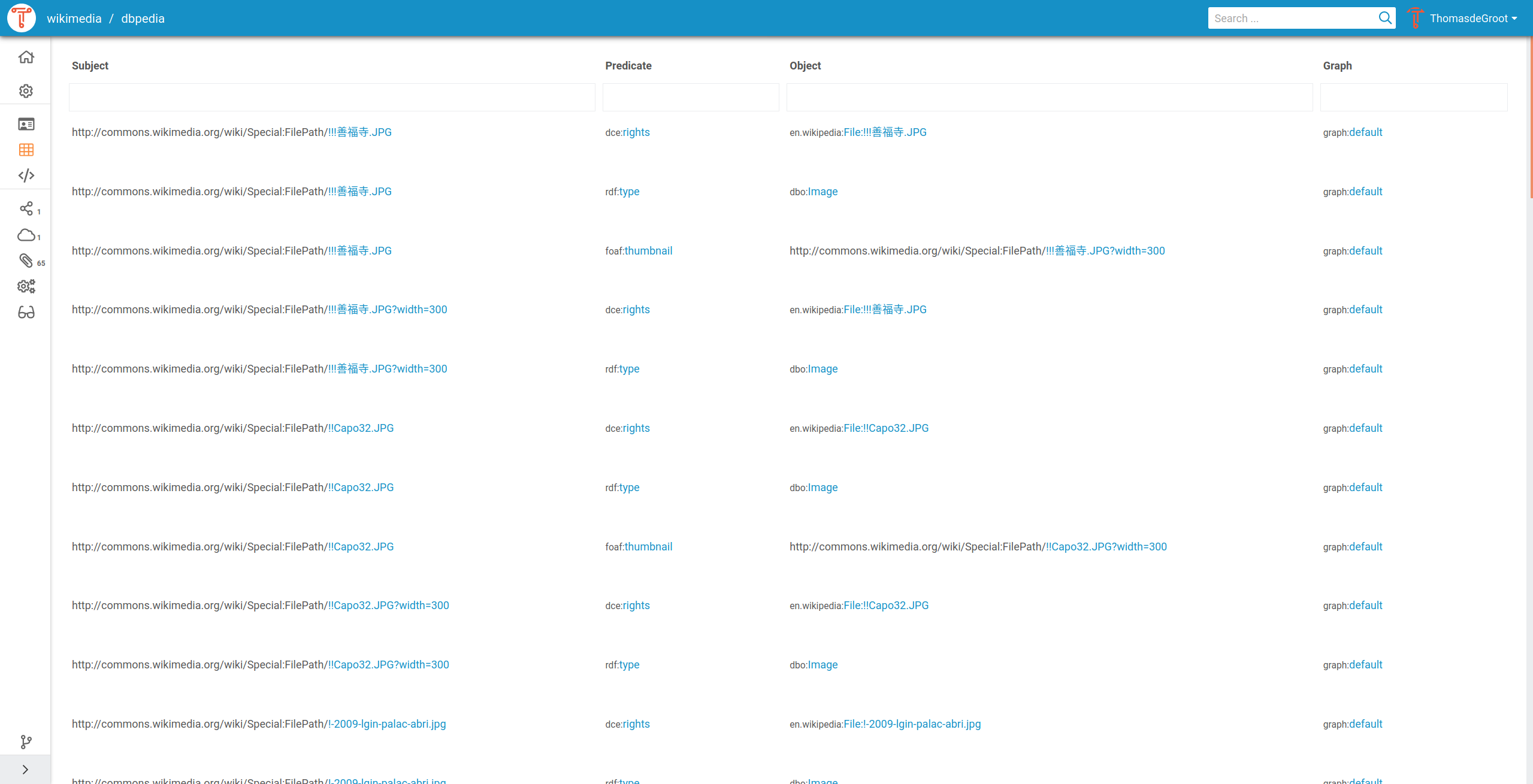
A dataset is a collection of triples. Within a dataset, named graphs group statements that belong together — one graph per source file, per import run, or per data model. In TriplyDB you can see this directly: the linked data table shows the subject, predicate and object of every triple, and a fourth column for the graph it belongs to.
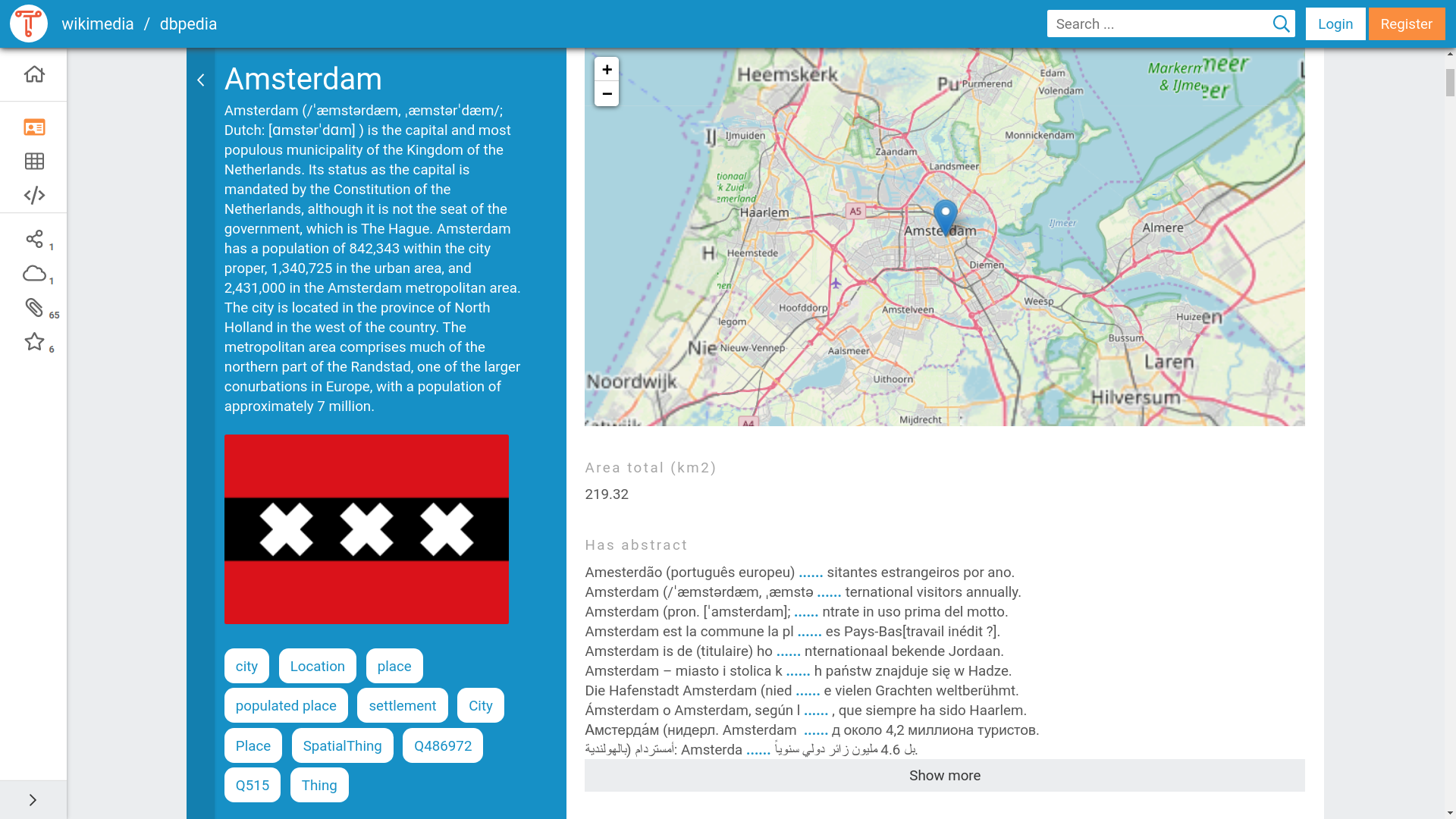
The same data can also be read one resource at a time. The linked data browser shows a single node with its properties, and you follow a property to move to the next node.
Why not a relational database?
A relational database is built around a fixed schema. It performs well when you know what your data looks like and that shape rarely changes. Linked data is the better fit when:
- The structure keeps changing. A new kind of fact needs a new predicate, not a migration.
- The data comes from several sources. Datasets from different organisations merge by loading them into the same store and querying across them.
- The data is uneven. Not every instance needs the same properties. That is awkward in a relational model and normal in linked data.
- Other systems need to read it. A system that has never talked to yours can consume your data, because the standards and the identifiers are public.
This is also the reason linked data is the usual answer to the FAIR principles for research and government data. Two of the four FAIR requirements — that data carry globally unique, persistent identifiers, and that they use shared vocabularies — are properties linked data has by construction rather than by policy.
The cost is real too. You have to decide on IRIs before you publish, agree on vocabularies with the people you exchange data with, and accept that a triple store is not the right place for high-volume transactional writes.
Where this appears in Triply products
- TriplyDB stores your data as triples and shows them in the linked data table and the linked data browser. See Data views.
- SPARQL queries these triples by matching patterns against them. See SPARQL.
- Terms used on this page are defined in the Glossary.
Where to next
- Knowledge graphs — what happens when connected data grows past a single dataset
- OWL and ontologies — agreeing on what your terms mean
- SPARQL — asking questions of the triples you have just met
- Glossary — every term on this page, in one place